

The product-related datasets of large e-commerce businesses serve as their essential foundation, enabling their product discovery process, customer conversion mechanisms, regulatory compliance efforts, and the establishment of consumer confidence. The process of entering product data into systems is one of the most neglected operational challenges businesses face as they grow. As catalogs grow in size and complexity, flaws in product data execution emerge quickly and on a massive scale. Processes made for smaller catalogs fail as SKU volumes reach hundreds or millions. Operational risk and delays are introduced by manual workflows, fragmented ownership, and variable standards. At this stage, many organizations formalize product data entry in ecommerce through external support models that provide structure, accountability, and scalability.
For decision makers, the focus then shifts to how the benefits of scaled execution can be realized while managing the risks that come with external delivery.
Why Product Data Entry Becomes a Growth Constraint
Product data entry rarely fails all at once. It becomes a constraint gradually, then visibly.
The SKU scale exceeds the internal capacity
Variants, bundles, regional attributes, and seasonal updates create persistent backlogs. Managing SKU data entry in ecommerce at this scale overwhelms internal teams without dedicated capacity.
Strategic teams lose focus
Merchandising, marketing, and channel management teams spend more time editing listings than on price strategy, promotions, and growth activities.
Data quality degrades silently
Manual entry leads to inconsistent attributes, missing images, pricing errors, and duplicate SKUs. These issues reduce discoverability and weaken buyer confidence.
Launch timelines become unreliable
If product data is incomplete and campaign schedules outpace catalog readiness, then the listings go live late. Competitors reach the market faster.
Individually, these issues seem manageable. Collectively, they signal the need for a more structured approach. This is why businesses outsource ecommerce product data entry services.
Key Benefits of Outsourcing Ecommerce Product Data Entry
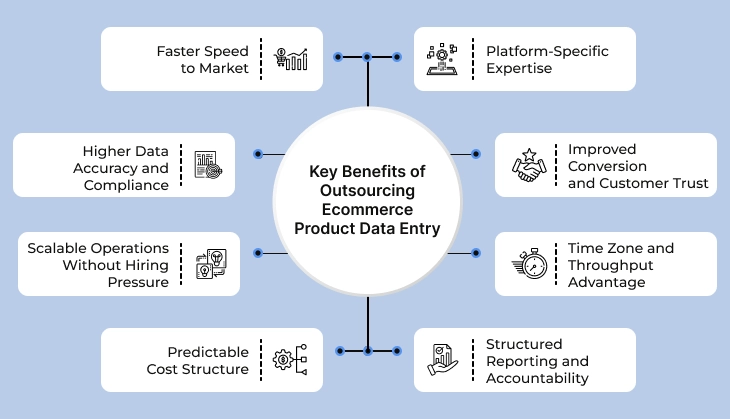
Enterprises outsource product data entry to stabilize catalog operations and scale seamlessly. Some of the top benefits that can be realized when the delivery is governed and measurable are:
Faster Speed to Market
Dedicated external teams process product data in parallel with internal planning. New SKUs go live on time without waiting for internal bandwidth.
Higher Data Accuracy and Compliance
Standardized validation rules and platform-specific requirements reduce listing errors, rejections, and rework across marketplaces and regions.
Scalable Operations Without Hiring Pressure
Capacity scales during seasonal peaks and expansions without recruitment cycles, training overheads, or attrition risk.
Predictable Cost Structure
Volume-based pricing replaces fluctuating internal effort. Leadership gains visibility into catalog operations and avoids hidden opportunity costs.
Platform-Specific Expertise
Experienced teams understand marketplace requirements and enterprise PIM environments, reducing approval delays and corrective cycles.
Improved Conversion and Customer Trust
Complete, consistent listings improve search relevance, reduce buyer hesitation, and strengthen cross-channel credibility.
Time Zone and Throughput Advantage
With offshore data entry for ecommerce, enterprises benefit from overnight processing, continuous output, and faster turnaround without overtime or burnout.
Structured Reporting and Accountability
Defined SLAs, accuracy benchmarks, and escalation paths introduce measurable discipline into catalog operations.
Commonly Outsourced Ecommerce Product Data Entry Activities
At enterprise scale, organizations treat product data entry outsourcing as an ongoing operational function rather than a one-time project. Some of the most commonly outsourced ecommerce product data entry tasks include:
• Updating product titles, descriptions, and structured attributes
• Feature and specification entry
• Attribute normalization and taxonomy alignment
• Image tagging and media uploads
• Managing pricing, inventory, and variant updates
• Bulk SKU uploads and catalog migrations
• Marketplace-specific listing creation
• Legacy catalog cleanup and standardization
These activities are typically managed under a Data Entry Outsourced model with defined governance and reporting.
Common Challenges in Ecommerce Product Data Entry Outsourcing
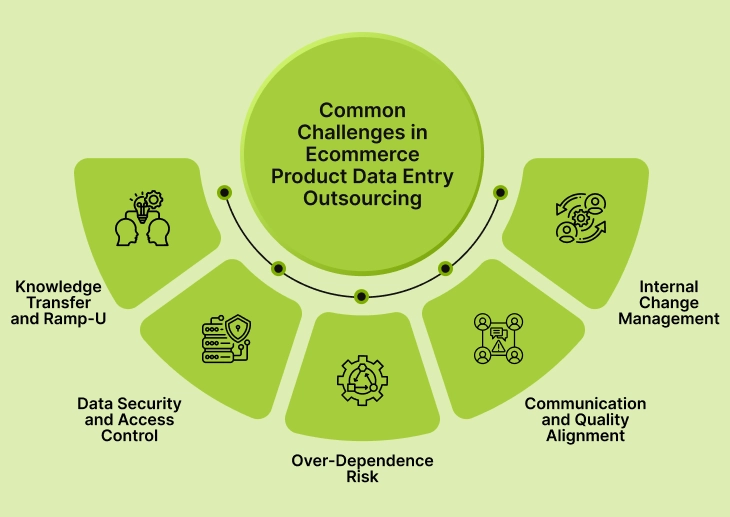
While the upside is significant, enterprises must actively manage challenges to avoid downstream risk.
Knowledge Transfer and Ramp-Up
Product rules are often undocumented and category-specific. Phased onboarding and structured documentation reduce transition risk.
Data Security and Access Control
Product data includes pricing and supplier information. Vendors must operate within defined security and compliance frameworks.
Over-Dependence Risk
Internal ownership cannot be compromised. Performance monitoring and governance must remain active throughout the engagement.
Communication and Quality Alignment
Early differences in expectations and platform nuances require clear SOPs and feedback loops.
Internal Change Management
Teams need clarity around ownership boundaries. Leadership alignment is essential when execution shifts to a data entry outsourced model.
Best Practices for Maximizing Outsourcing Outcomes
Execution discipline determines long-term value. Here are some best practices that help maximize the benefits of outsourcing ecommerce product data entry.
• Begin with a controlled pilot engagement
• Define accuracy thresholds and turnaround benchmarks
• Maintain a single source of truth for product data
• Review SLAs and performance metrics regularly
• Treat the vendor as a governed operational extension
Final Perspective for Enterprise Decision Makers
At enterprise scale, e-commerce performance depends on how effectively product data operations are executed, with speed, accuracy, and consistency functioning as competitive requirements rather than optional improvements.
When organizations adopt a structured approach to ecommerce product data entry, the objective is not simple task delegation but operational resilience. Poorly governed execution introduces risk, while well-managed partnerships create leverage and stability across catalog operations.
As a result, the choice involves more than just outsourcing. The goal is to create a robust product data operation that can accommodate long-term expansion without accruing unnoticed operational debt as complexity rises.
Results in e-commerce are determined by how reliably product data operations deliver complete, accurate, and timely listings across every sales channel.
FAQ
Q1. How does DEO manage large SKU volumes?
DEO deploys scalable offshore teams, bulk-processing workflows, and platform-ready templates to handle millions of SKUs without compromising accuracy or turnaround time.
2. What quality controls does DEO follow?
DEO applies multi-level validation, category-specific SOPs, and SLA driven accuracy benchmarks to ensure consistent, error-free product data delivery.
3. Can DEO support multi-marketplace requirements?
In order to ensure consistency across all sales channels, DEO aligns product data with Amazon, Shopify, Magento, and custom PIM standards.
4. How quickly can DEO onboard new catalogs?
DEO follows a phased onboarding model with rapid knowledge transfer, pilot runs, and parallel processing to accelerate go-live timelines.
5. How does DEO ensure data security?
DEO operates under strict access controls, secure infrastructure, NDAs, and compliance-driven data-handling protocols across its offshore delivery centers.
 Prev
Prev