

Enterprises depend on external digital signals to understand shifting markets and competitors. Public websites reveal pricing movements, listing changes, customer behavior, and emerging demand patterns. This visibility explains why a business might use web scraping to collect data. Problems emerge once scraping efforts move beyond experimentation into sustained operational dependency. Extracting limited pages is simple, but maintaining reliable pipelines for scraping web data is difficult.
Websites change behavior frequently, and protection mechanisms evolve without public notice. Minor inconsistencies quietly escalate into widespread failures across dependent data systems. These web scraping challenges rarely appear during early pilot phases. They surface only when analytics, reporting systems, and operational workflows begin to depend on scraped data. Understanding challenges in web scraping early reduces rework, mistrust, and operational disruption.
Why Web Data Scraping Is Challenging
Web data scraping operates outside enterprise-controlled systems and stable internal environments. Unlike internal databases, websites change structures without warning or backward compatibility. Scraping web data must adapt continuously to unpredictable external technical conditions. Scale amplifies fragility when data volumes, sources, and refresh frequencies increase simultaneously, increasing the likelihood of failures.
Minor website adjustments can silently degrade the accuracy of web scraping data extraction. Without early detection, incorrect data propagates downstream before issues arise. This makes large-scale web scraping challenges harder to diagnose than traditional data integration failures.
What is Enterprise-Scale Web Data Scraping?

Enterprise-scale web scraping operates as a continuous production system. It delivers consistent datasets at predictable intervals across diverse external sources. Manual fixes or occasional script execution cannot meet enterprise reliability requirements. Accuracy, lineage, and traceability matter as much as extraction speed. Robust web data-scraping tools orchestrate the collection, parsing, validation, and storage layers. Failure tolerance becomes mandatory as volume, source diversity, and dependency grow. This becomes especially clear in use cases such as a data extraction solution for real estate operations, where listing freshness affects decisions, and in automated data extraction in healthcare, where data gaps introduce significant risks. At this scale, web data scraping becomes infrastructure, not experimentation.
Major Technical Challenges
Enterprise web data scraping does not fail for one reason. It fails for many reasons, often simultaneously. Dynamic websites are usually the first obstacle. Content rendered through JavaScript or asynchronous calls does not behave like static HTML. Without proper handling, large sections of data never get captured. Scraping web data suddenly requires more resources and more logic than expected.
Anti-bot defenses introduce ongoing friction. Websites watch traffic patterns closely. When behavior looks automated, access is restricted. This is one of the most common breaking points in web scraping data extraction pipelines built without adaptive controls.
Website changes happen quietly and often. A renamed class or reordered element may not crash a scraper. Instead, it produces partial data. This silent degradation is one of the most dangerous web scraping challenges in large-scale extraction because it erodes confidence slowly.
Data quality issues follow. Duplicate records appear. Fields go missing. Formats drift. Without validation, teams discover problems only after the analysis is already wrong.
Scalability eventually becomes unavoidable. Scripts that perform well in isolation struggle when workloads increase. Without distributed processing and fault tolerance, performance degrades under pressure.
Operational and Compliance Challenges
Technical success alone does not ensure sustainable web data scraping operations. Legal and ethical constraints define the acceptable boundaries of data collection. Enterprises must be transparent about what data is extracted through web scraping and how it is used. Regulations, terms, and regional rules matter, and ignoring them introduces a risk that outweighs short-term gains. Security and governance add another layer. Web data scraping services often involve credentials, proxy networks, and sensitive datasets. Weak controls increase exposure.
Maintenance is constant as scrapers require monitoring, alerting, and regular adjustment. When ownership is unclear, issues surface only after business teams notice something is wrong.
How to Overcome These Challenges
Successful enterprise web scraping starts with discipline rather than tools. Architecture matters: crawling, extraction, validation, and storage should be decoupled. This limits the impact when a single layer changes. Dynamic rendering should be used intentionally, not universally.
Anti-blocking works best when behavior stays consistent. Predictable request patterns, reasonable pacing, and session awareness are more effective at reducing detection than aggressive automation.
Change detection prevents surprises. Monitoring structure shifts, volume anomalies, and missing fields allows teams to respond before insufficient data spreads.
Data validation stabilizes outcomes. Schema checks, normalization, and historical comparisons ensure that web scraping data extraction outputs remain usable over time.
Scalability depends on infrastructure choices. Distributed execution, queues, and elastic resources allow web data scraping services to grow without becoming operationally fragile.
Build vs Outsource Web Data Scraping
The decision to build or outsource web data scraping services is rarely binary. Internal teams gain control but absorb long-term responsibility. Engineering talent, monitoring systems, and compliance oversight all require ongoing investment. Ongoing maintenance often outweighs initial development effort.
Outsourcing shifts that burden. Engaging an experienced data extraction services company brings proven architectures, active monitoring, and lessons learned from similar deployments. This allows internal teams to focus on insights rather than extraction mechanics.
What to Look for in a Large-Scale Web Data Scraping Partner
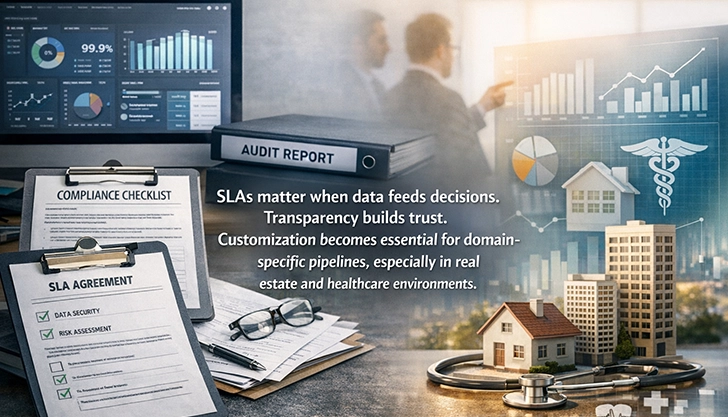
Enterprise readiness is reflected in documented compliance practices and repeatable operational processes. Strong partners define quality thresholds and track them with measurable accuracy.
SLAs matter when data feeds decisions. Transparency builds trust. Customization becomes essential for domain-specific pipelines, especially in real estate and healthcare environments.
Conclusion and Strategic Takeaways
Enterprise web data scraping is difficult because it sits at the intersection of evolving technology, operational realities, and regulatory boundaries. Dynamic websites, anti-bot defenses, and scaling constraints expose weak designs quickly. Successful organizations view scraping as a long-term capability backed by structure and governance.
A methodical strategy transforms external data into a dependable operational resource rather than a recurring source of failure, whether managed internally or through reliable web data scraping services. When done well, web data scraping does not require continual attention but instead becomes a quiet, reliable input for better decisions.
FAQs
Q1. What is web data scraping in simple terms?
Web data scraping is the automated collection of information from websites for analysis or business use.
Q2. What is the difference between crawling and scraping?
Crawling discovers web pages, while scraping extracts specific data from those pages.
Q3. What is anti-bot detection?
Anti-bot detection identifies and blocks automated access based on behavior, traffic patterns, and fingerprints.
Q4. What is data normalization in production scraping pipelines?
Data normalization converts scraped data into consistent formats for easy comparison and analysis.
Q5. What is change detection in scraping pipelines?
Change detection identifies website updates that may break extraction logic or alter data structure.
 Prev
Prev