
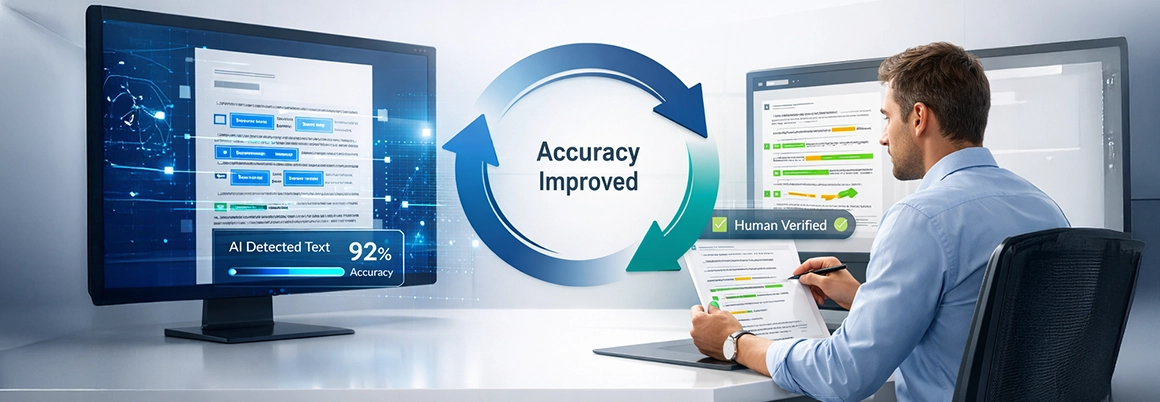
In high-volume document environments, OCR accuracy is no longer a technical metric. It is an indicator of business risk. Businesses that handle contracts, shipping documents, KYC information, invoices, and claims are under increasing pressure to extract data more quickly without sacrificing compliance. This is exactly where AI-based OCR solutions make a difference. Here, organized human validation, in combination with AI OCR services, yields quantifiable benefits. Instead, by focusing on theoretical automation goals, providers such as Data Entry Outsourced have improved this integration to meet actual operational obstacles.
However, the variety of real-world documents cannot be handled solely by OCR. Business executives are slowly realizing that coordination, not replacement, is the key to accuracy. For downstream AI models, the same idea is accurate. OCR outputs cannot support analytics, ERP ingestion, or regulatory reporting without clean, verified data pipelines and AI Data Annotation discipline. This gap is filled with predictable results by the use of AI and human OCR.
Why Standalone OCR Still Fails at Scale
Many enterprises adopt an AI-based OCR solution, expecting straight-through processing. The reality is more complex.
Key failure points decision-makers encounter:
- Low OCR accuracy with complex documents
Multi-column layouts, handwritten fields, stamps, poor scans, and mixed languages still confuse AI-powered text recognition engines. Accuracy drops sharply beyond structured templates. - High manual verification requirement
Internal teams spend excessive time validating OCR outputs. This negates automation gains and inflates processing costs. - Slow document processing speed
Rework cycles, exception handling, and manual corrections delay downstream workflows, including billing, fulfillment, and compliance reviews.
OCR integration without governance creates hidden operational drag.
What AI–Human OCR Integration Actually Means
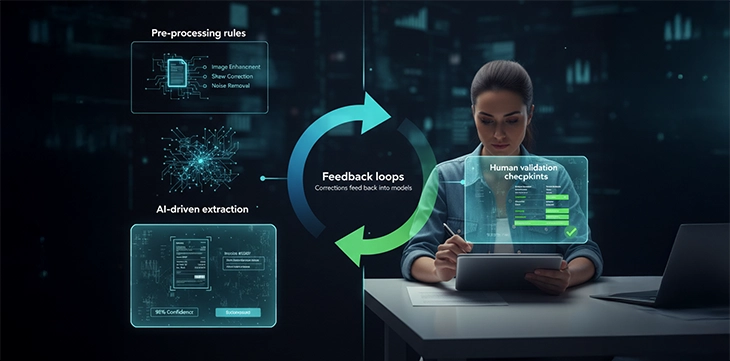
AI OCR integration is not about humans randomly fixing machine errors. It is a structured workflow design where AI-based OCR solutions are combined with human reviews while performing data digitization and extraction projects.
At an operational level, integration includes:.
- Pre-processing rules
Document classification, image enhancement, skew correction, and noise removal before OCR runs. - AI-driven extraction
AI-driven OCR solutions handle predictable fields at scale using trained models. - Human validation checkpoints
Trained operators review only low-confidence fields, not entire documents. - Feedback loops
Corrections feed back into models to improve future accuracy.
This model keeps humans where judgment matters and machines where speed matters.
How 99% Accuracy is Achieved Consistently
Accuracy at this level is not accidental. It is maintained through AI-based OCR solutions coupled with human quality checks.
Critical elements that drive measurable gains in accuracy:
- Confidence thresholding
AI flags only fields with confidence scores below the defined threshold for review. This reduces manual effort while protecting data quality. - Domain-specific model tuning
Models trained on healthcare forms differ from those trained on logistics manifests or financial statements. As a result, generic OCR often underperforms in regulated industries. - Dual-layer validation
Sensitive fields such as amounts, dates, IDs, and names undergo secondary checks. - Standardized quality metrics
Accuracy is measured per field, not per document. This aligns better with ERP and BI requirements.
This approach delivers consistent, predictable, and auditable performance.
Operational Benefits of AI-Based OCR Solutions for Enterprise Stakeholders
For CEOs, VPs, and Managing Directors, OCR success is measured in outcomes, not features.
Business-level advantages include:
- Reduced cost per document
Less rework and fewer full-document reviews lower operational expenditure. - Faster cycle times
AI OCR integration reduces turnaround times for invoicing, claims, onboarding, and reporting. - Improved compliance
Consistent data extraction reduces audit discrepancies and reconciliation errors. - Scalable capacity without headcount spikes
AI layers absorb volume surges without proportional staffing increases.
This shifts OCR from a support function to a growth enabler.
Where AI-Based OCR Solutions Deliver the Most Value
Not all document workflows benefit equally from using AI-based OCR solutions. Integration matters most where complexity and volume intersect.
High-impact use cases include:
- Accounts payable and receivable
Invoices with varied layouts, tax structures, and currencies. - Insurance claims processing
Mixed handwritten and typed forms with supporting attachments. - Banking and KYC operations
Identity documents, address proofs, and regulatory forms. - Logistics and supply chain
Bills of lading, packing lists, customs documents.
In these environments, pure automation fails silently. Integrated models identify exceptions early.
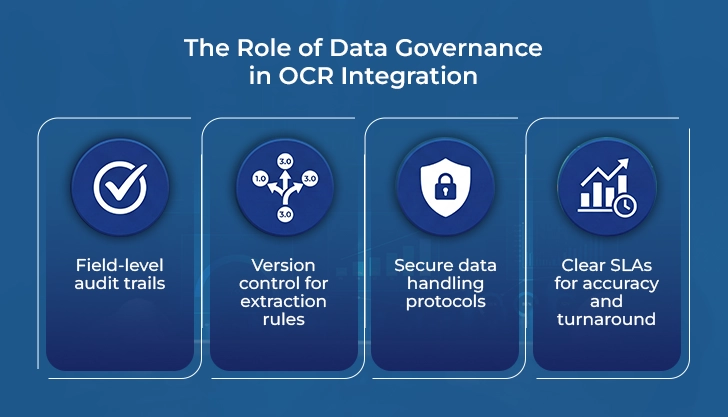
The Role of Data Governance in OCR Integration
OCR outputs feed multiple enterprise systems. Poor governance multiplies errors downstream.
Strong OCR integration frameworks include:
- Field-level audit trails
Every correction is logged for traceability. - Version control for extraction rules
Changes in document formats are tracked and managed. - Secure data handling protocols
Access controls aligned with industry regulations. - Clear SLAs for accuracy and turnaround
Metrics tied to business outcomes, not technical uptime.
This level of control reassures compliance officers and board-level stakeholders.
Why Human Expertise Still Matters
Human intervention is not a bottleneck. It is a risk control mechanism when implementing AI-based OCR solutions.
Human reviewers add value by.:
- Interpreting ambiguous fields, which AI cannot contextualize
- Resolving discrepancies across multi-page documents
- Applying business rules that vary by client or geography
- Preventing cascading errors in financial and legal records
The goal is not to eliminate human intervention but to deploy it as an added layer of quality check to enhance the performance of AI-based OCR solutions.
Avoiding Common OCR Integration Pitfalls
Many organizations struggle not because of technology but because of execution.
Mistakes to avoid:
- Deploying OCR without document classification
- Using generic models for regulated industries
- Measuring success only by automation rate
- Ignoring feedback loops from human corrections
- Underestimating change management
OCR integration succeeds when treated as a process redesign, not a software install.
Evaluating an OCR Integration Partner
Vendor selection determines long-term value. Here are key factors to evaluate in a potential outsourcing partner:
- Proven experience in processing industry-specific documents
- Ability to customize confidence thresholds
- Maintain transparency through accurate field
- Secure, compliant operational infrastructure
- Scalability across geographies and volumes
A reliable partner should improve data quality to support informed decision-making, not just extraction speed.
The Strategic Takeaway for Business Leaders
AI-powered text recognition has matured, but enterprise readiness varies. Organizations that combine AI OCR integration with disciplined human validation achieve stability, accuracy, and scale. Those chasing full automation often absorb hidden costs.
For leadership teams, the question is not whether OCR works. It is whether your OCR workflow supports revenue growth, compliance, and operational resilience. Integrated models answer that question with data, not assumptions.
In a market where speed and accuracy define competitiveness, AI–human OCR integration is no longer optional. It is a critical part of modern data processing infrastructure.
FAQ
- How does DEO ensure OCR accuracy at scale?
DEO applies field-level confidence scoring, domain-trained models, and expert validation to achieve consistently near-perfect extraction accuracy. - Can DEO handle industry-specific document complexity?
Yes. DEO customizes OCR workflows for finance, healthcare, logistics, and legal documents with varied layouts and compliance needs. - How does DEO reduce manual verification efforts?
Only low-confidence fields are routed for human review, cutting verification time while maintaining strict data quality benchmarks. - Is DEO OCR integration secure and compliant?
DEO uses enterprise-grade security controls, access governance, and audit-ready workflows aligned with global compliance standards. - How quickly can DEO scale OCR operations?
DEO’s hybrid delivery model scales volumes rapidly without impacting turnaround times or agreed accuracy levels.
 Prev
Prev